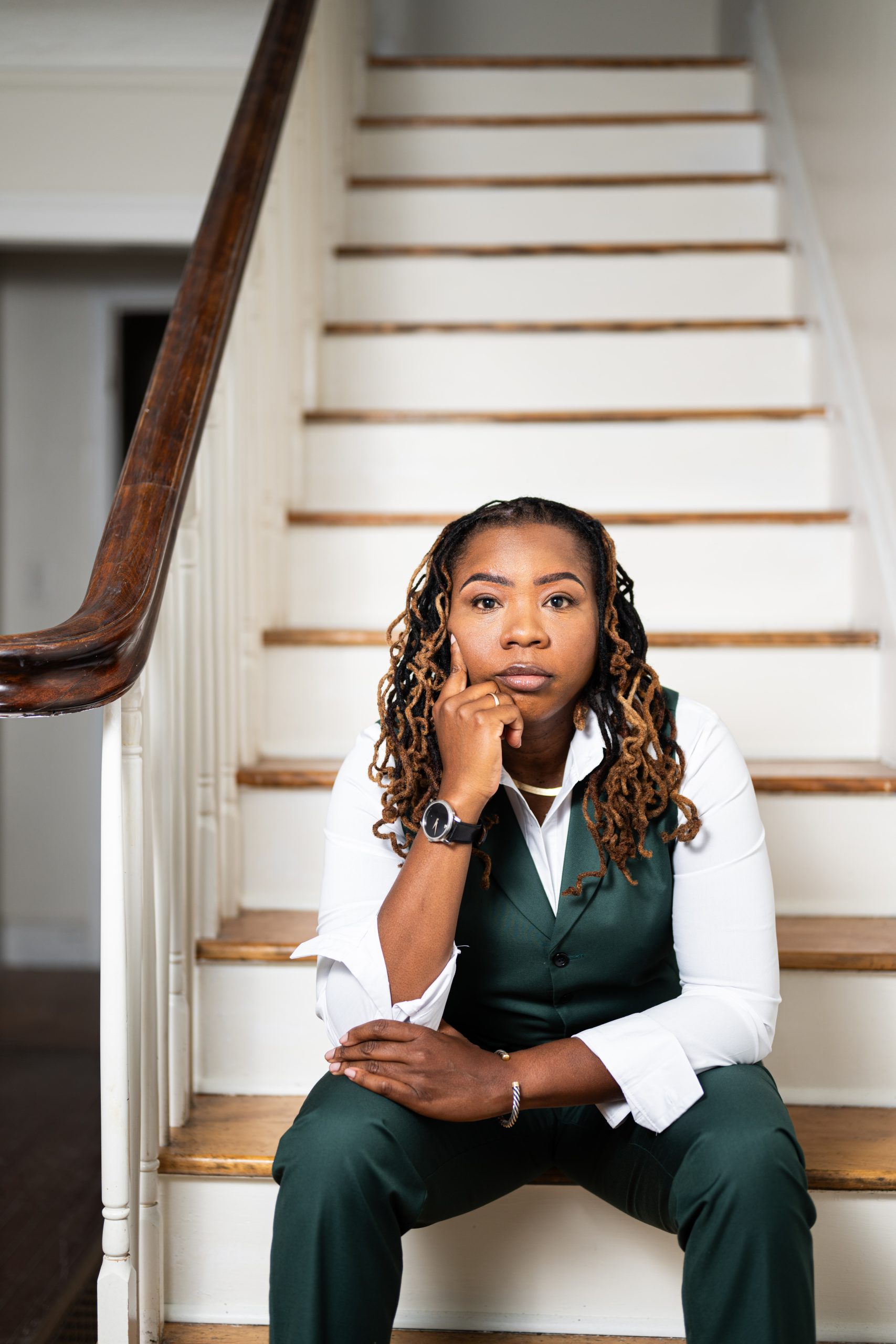
Angela M. Wright is among a growing generation of Black women entrepreneurs building businesses across industries traditionally dominated by men. Operating at the intersection of commercial real estate, nightlife ownership and live entertainment, her multi-hyphenate lane as the “Culture Capitalist” is rooted in a simple premise: culture is currency.
Long before commercial real estate developments transformed post-bankruptcy Detroit, Wright was on the front lines of the city’s cultural economy. Recognized as DJ Lynda Carter, the prominent culture capitalist is a venue owner, real estate broker and community advocate who has spent more than two decades turning creative energy into tangible business and property assets.
Born in Wiesbaden, West Germany, to Jounice Blackmon Wright and John Larry Wright, Angela arrived in Detroit as a child, attending Taft Middle School and graduating from Henry Ford High School. After earning her bachelor’s degree from Western Michigan University and a master’s in instructional technology from Wayne State University, she began hosting events. She earned her real estate broker’s license in 2008.
From that foundation, she launched, owned and operated four distinct Detroit hospitality brands under Wright Hospitality: Mix Bricktown, The LOCKEROOM Sports Lounge, Sandbox and Me & You. Public profiles of Wright describe her as a Detroit-based entrepreneur, educator, real estate broker and hospitality owner, with a portfolio spanning multiple parts of the city.
Wright’s career is a prime example of what can happen when an entertainment entrepreneur moves beyond creating experiences and begins to secure ownership of the physical spaces where those experiences occur.
View this post on Instagram
How Does Viewing Culture as Currency Drive Strategic Commercial Property Ownership?
Event organizers and venue operators can build substantial business value while remaining tenants of the properties where that value is created. Wright recognized early in her career that long-term enterprise sustainability required stepping out of the DJ booth and securing real property.
Her first venue deal in Ferndale was structured as a seller-financed land contract for both the business and the real estate. When that partnership dissolved, she struck out on her own to launch Mix Bricktown in 2011—originally known as Presto Lounge—in Detroit’s historic Bricktown district.
Mix Bricktown became the first piece of what would eventually become a broader hospitality portfolio. The LOCKEROOM Sports Lounge followed in 2018, while Sandbox and Me & You expanded Wright’s footprint into additional hospitality and entertainment concepts. Public business profiles identify MIX as established in 2011 and The LOCKEROOM as a longtime Detroit institution that Wright has owned since 2018.
“I was down there years before all of this emergence began,” Wright says, recalling the period around Detroit’s 2013 municipal bankruptcy filing. “I was already enthralled in the real estate community at the same time that I was enthralled in the culture as a DJ.”
A pivotal moment occurred in May 2017 when Wright graduated from the Goldman Sachs 10,000 Small Businesses Program. The experience reinforced her push to secure real property assets. When city leaders announced major infrastructure and corridor investment plans for the Avenue of Fashion along Livernois, Wright took action in the nearby University District—where she had owned a home for a decade.
“An alarm went off,” Wright explains. “I never wanted to be in a position where I had worked so hard to build a brand that someone could easily kick me out of. It’s not enough for me to own the business. I have to own the property, too. If something happens to me downtown, I have this piece of land and this piece of legacy within the city that I can call my own and build on.”
That philosophy is at the heart of Wright’s approach to culture as currency: building a brand is one thing; owning the property behind that brand creates another level of control, stability and legacy.
What Operational Philosophy Allows Wright Hospitality to Scale Four Concepts Simultaneously?
Managing four hospitality concepts across Metro Detroit requires Wright to maintain consistent standards without making each business feel interchangeable.
For Wright, sustaining high service standards relies on prioritizing emotional connections over cold transactional mechanics.
While many operators treat customer service as a routine checklist, Wright approaches hospitality as relationship-building. Her core strategy centers on creating genuine human connections inside her venues and turning those relationships into long-term social capital.
“My whole business was built on the strength and the importance of customer service. It’s gotta be the thing that makes the business—making sure that you understand your guests, you get to know your guests, you get to know about their family. People come there to create memories.” — Angela M. Wright
Wright summarizes her management approach: leading with heart.
“Serve with heart, entertain with heart, deal with heart,” she says. “My heart is in everything that I do. If my heart’s not in it, I’m not doing it. Money will come.”
That internal focus guides how she reads crowds, tests new concepts and designs entertainment environments. Rather than simply chasing short-term market trends, Wright evaluates how a physical space makes guests feel—a principle informed by her years behind the turntables as DJ Lynda Carter.
How Does Angela M. Wright Preserve Legacy Black Spaces While Scaling Commercial Property Assets?
Preserving a longtime neighborhood institution requires a different strategic posture than launching a new bar.
When Wright acquired The Locker Room Sports Lounge in 2018, she sought to honor its legacy while updating its operations to meet the needs of a changing Livernois corridor. The LOCKEROOM , established decades earlier, had already become a neighborhood institution by the time Wright took ownership. Contemporary coverage of the acquisition noted that Wright retained existing staff and emphasized the importance of preserving the business’s atmosphere and community.
 Rather than overhauling the venue immediately, Wright retained existing staff and learned from the community. She interviewed bartenders who had served the establishment for more than 25 years and listened to longtime regulars to understand the bar’s history.
“I became a fixture in the space. I listened to their stories,” Wright says. “I made a mural and put a wallpaper mural on the wall of longtime regulars who passed away—whether during COVID or before—that helped make the space what it is. So when I reopened, people could come back in and see that it was still theirs.”
That philosophy was reflected in the physical renovation as well. A neighborhood publication noted that the updated Locker Room retained its connection to longtime customers while introducing new design elements and programming.
To modernize the business model, Wright updated the venue’s event schedule, shifting Sunday programming from traditional live bands to weekly karaoke. She adjusted the age entry threshold to 30 and up, creating a multi-generational space where adult children could celebrate alongside their parents.
Wright says the property’s market valuation has increased four- to five-fold since her initial purchase.
The grounded boss has also created a path for longtime employees to earn an ownership stake in her businesses. A prime example is Courtney Sanders, who joined Mix Bricktown as a bartender shortly after its 2011 launch. Over 14 years of operational service, Sanders earned sweat equity in Wright’s organization.
“The best way for me to preserve culture is through team building and education within the framework of my organization,” Wright stated.
View this post on Instagram
The multihyphenate also extends and expands that knowledge and cultivation to a community of aspiring entrepreneurs.
View this post on Instagram
For Wright, preservation isn’t simply about keeping an old business open. It’s about making sure the people, memories and relationships that gave the space meaning remain part of its next chapter.
What Does “Culture as Currency” Mean for Black Wealth Building?
For Wright, the concept extends beyond nightlife.
Her career illustrates a broader strategy for Black entrepreneurs: use cultural influence to create businesses, use those businesses to create assets, and use those assets to create greater control over the future.
That distinction matters in Detroit, where neighborhood businesses can become part of a community’s institutional memory while also operating inside rapidly changing commercial corridors.
Wright’s approach brings her “culture as currency” philosophy full circle. Build the brand. Own the space when possible. Invest in the people who help sustain it. And preserve the history attached to the business.
Through Wright Hospitality, her work as DJ Lynda Carter and her growing real estate portfolio, Wright continues to build at the intersection of culture, commerce and community—proving that the value of a cultural institution isn’t only measured by the money it generates.
Sometimes, the real value is in who gets to own it, who gets to shape it and who gets to see themselves reflected in what comes next.
RELATED CONTENT: Kelly Rowland Backs VP Kamala Harris’ Homeownership Plan