

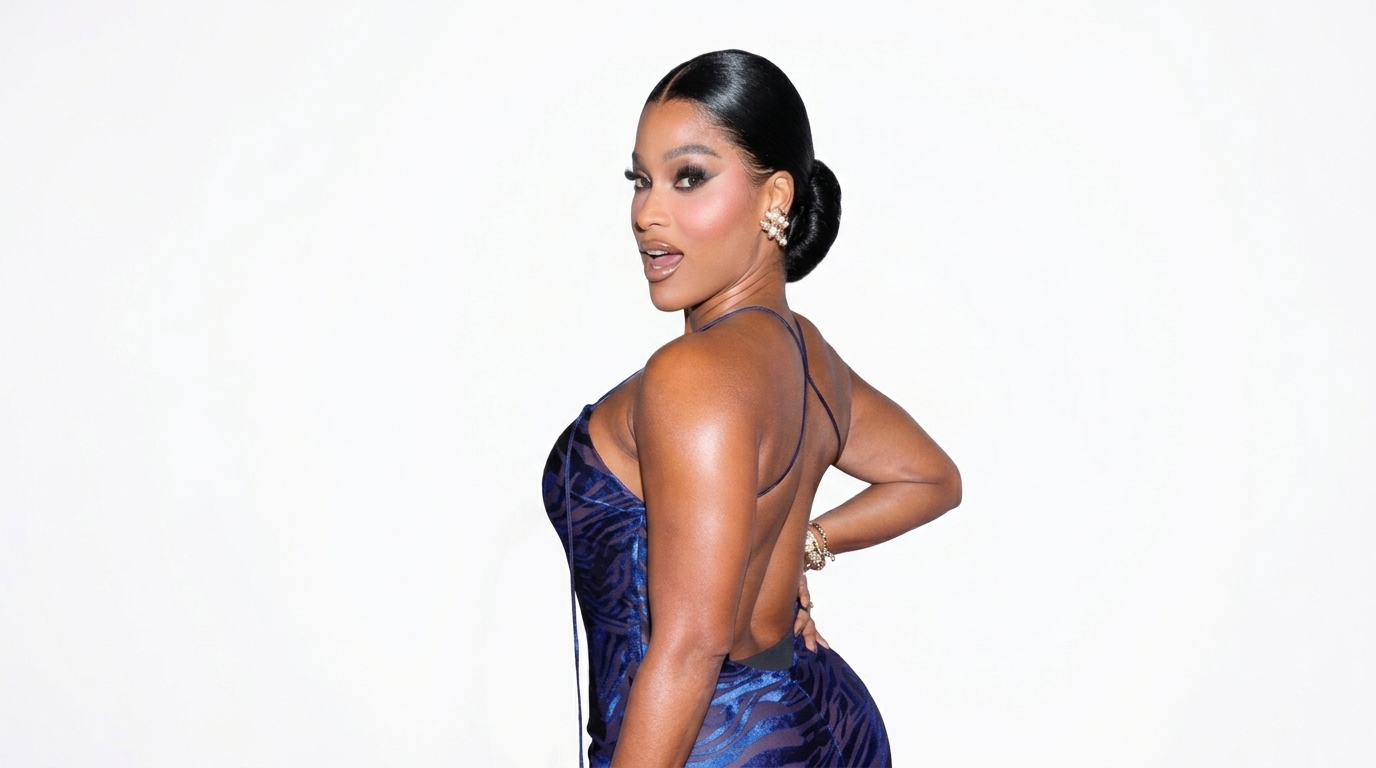
Reality television powerhouse Joseline Hernandez dug deep and set fans and foes straight about her Blackness and evolution in an almost two-hour interview on Shannon Sharpe’s uber-popular Club Shay Shay podcast, released Sept. 16, 2026.
Hernandez, 39, used her characteristic no-nonsense delivery to reclaim her narrative on the high-profile platform. By directly addressing her drama with VH1, highly publicized personal issues, and her Afro-Latina lineage, the self-proclaimed “Puerto Rican Princess” moved beyond sensational tabloid headlines to showcase her growth as a producer, mother, and media executive.
Does Joseline Hernandez Define Herself as Afro-Latina?
Sharpe candidly asked the “Puerto Rican Princess” how she defined herself and about the people on the Caribbean island.
“Are Puerto Ricans Black?”
“I consider myself Black. I’m a Black woman. I’m Black as you,” Hernandez explained.
Sharpe seemingly dismissed Hernandez’s very accurate response and pressed her about how people on the small island identify racially.
“Naw, but do all Puerto Ricans — how do they consider themselves?”
A quick Google search could’ve answered that, but Sharpe put the weight of an island’s identity on the expectant mother’s back. And she carried that shit.
Putting to rest any rhetoric regarding her race, Hernandez explicitly outlined her roots to the host and attacked the insidious anti-Black sentiment often embedded within the Spanish-speaking Caribbean.
“Some of them, if they are black… I’m hoping they consider themselves Black. But I feel like people born in Spanish places, right? Like, I was born in Puerto Rico; it’s a lot of white people in Puerto Rico, but it’s also a lot of Black people in Puerto Rico. My brothers are darker than you. Two of my brothers are darker than you.” Hernandez explained to Sharpe.
“Wow,” the former football star said.
She proceeded to expound that some people grew to “hate their own skin.”
Hernandez didn’t agree, though. She said she was a proud Black woman first, raising her 9-year-old daughter, Bonnie Bella, to embody deep self-love, taking direct action to dismantle generational cycles of colorism before they take root.
The reality television star stressed that her immediate family intentionally embraces their Afro-Latina lineage without compromise.
Hernandez expanded on the routine erasure of Blackness in Latin America, noting how social conditioning causes dark-skinned individuals to actively deny their roots.
“Growing up in PR… they don’t say, ‘Oh, I’m a Black Puerto Rican woman,’ because my skin is black and I’m Puerto Rican,” she explained on-camera. “When you grow up, and you’re Spanish, you are not Black, even if you are Black. That’s just what it is.”
What Is the History of Anti-Black Racism, Demographics, and Latinidad in Puerto Rico?
Hernandez’s comments about Blackness reflect a complicated racial landscape in Puerto Rico, where race, nationality and cultural identity do not always fit neatly into the categories used in the United States. The 2020 Census counted almost 6% of Puerto Rico’s population as Black alone, while 49.8% identified as two or more races and 25.5% selected “Some Other Race” alone. The Census Bureau also notes that race and ethnicity categories are based on self-identification and are not intended to define race biologically or culturally.
That complexity has deep historical roots. Puerto Rico’s population reflects Indigenous Taíno, Spanish and African ancestry, including the legacy of African enslavement and Spanish colonization. But the existence of that racial mixture does not mean Black Puerto Ricans experience race in the same way as lighter-skinned Puerto Ricans. Research on Blackness in Puerto Rico has found that the romanticized idea of the island as a mixture of three racial groups—White, Brown and Black—can obscure differences in how darker-skinned and Black-identified Puerto Ricans experience racism.
Color and racial identity can also complicate how Puerto Ricans describe themselves. A U.S. Census Bureau study of Puerto Rico found that some residents used terms such as trigueño to describe themselves as somewhere between Black and White. In contrast, others said the Census categories did not adequately reflect Puerto Rican identity or mixed ancestry. The study also found that some participants associated identifying as Black with a stigma.
That history helps put Hernandez’s comments into context. When she told Sharpe that some Puerto Ricans grow up learning that being Spanish means they are not Black, she was describing a racial identity debate that researchers have documented beyond her own experience.
Research on Blackness in Puerto Rico has similarly examined how colorism, racial mixing and the romanticization of trigueña can make it more difficult for Black Puerto Ricans to openly discuss their experiences with racism and claim their African ancestry.
For Hernandez, however, the distinction appears less complicated. She identifies herself as a Black woman and a Puerto Rican, and she connected that identity to how she wants her daughter, Bonnie Bella, to understand herself.
In doing so, her Club Shay Shay conversation placed a deeply personal question of identity inside a much larger Caribbean conversation about race, color and latinidad.
What Lies Ahead for the Puerto Rican Princess?
Hernandez is no longer waiting for traditional networks to determine what comes next. She is building an independent media business through Why Are You Here TV (WAYH TV), while developing new reality and talk-show projects that keep her firmly in control of the stories she wants to tell. The “Puerto Rican Princess” is also entering a new chapter in her personal life with her husband, Ballistic, as the couple prepares to welcome a baby to their brood.
She is also starring in Grandma Is The Baby, a reality series centered on her family, and recently filed a federal trademark for “THE GRANDMA IS THE BABY” as she explores a broader consumer brand. After years of television drama, public scrutiny and reinvention, Hernandez appears focused on turning her name, audience and experience into an independent entertainment enterprise—one where she controls the platform, the projects and, increasingly, the narrative.
View this post on Instagram
Today, Hernandez views her hard-won trajectory not merely as personal triumph, but as a blueprint for young Black and Latina women navigating predatory entertainment structures without losing their souls.
By honoring her Afro-Puerto Rican lineage, confronting generational cycles of colorism in real time, and scaling an independent reality television empire on her own terms, Hernandez reinforces her cultural sovereignty—proving that her unfiltered narrative reclamation is ultimately defined by ownership, spiritual growth, and enduring career longevity.


